

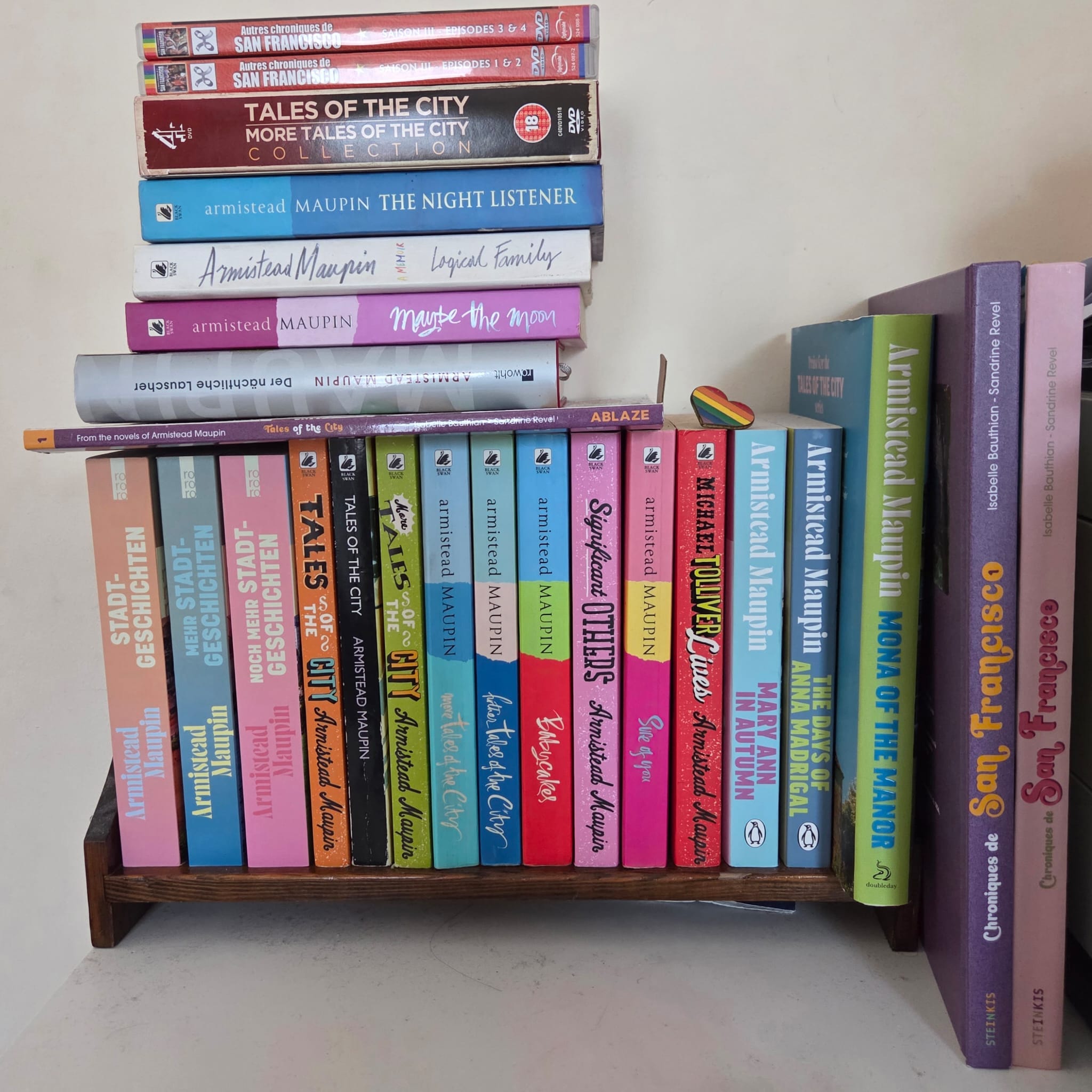
Fifty years ago, before I was even born, a young journalist named Armistead Maupin pitched an idea to a newspaper: he would write a daily story for the newspaper. The editor, Charles DeYoung Thieriot, agreed to a serial, “five days a week. Eight hundred words a day…. You can write a story that will just… keep on going?”
Maupin agreed, but in his later memoir Logical Family, he wondered: “How the fuck was I going to do that?” (p. 213, Armistead Maupin, 2017: Logical Family, Transworld Publishers, London). Nevertheless, he did, and five decades ago today, on Monday 24th May 1976, on page seventeen of the San Francisco Chronicle, the first tale was published of the now legendary Tales of the City. Newspapers hadn’t published daily fiction except comic strips for a hundred years, and here was young Maupin, reviving and reinventing a literary tradition that harkened back to Charles Dickens.
I first heard of Tales of the City in 1993, when Channel 4 was launching a TV miniseries based on the book. I was stopped from getting the book out of the library by a stern librarian who refused to allow teen me to borrow the book, because it had “gay content”; I was however allowed to take out the gruesome, gory and (hetero)sex-laden horror novels of Richard Laymon. I didn’t read it until many years later. Maupin’s characters covered a wide spectrum of society, humanising marginalised persons whom the mainstream media demonised. Maupin took a risk and was brave at the time to include queer characters in his San Francisco, and is now recognised as a literary pioneer for it. Inclusivity has always been at the core of his writing, and sometimes even getting political about it. Inclusivity means that someone marginalised by society gets to be seen and be truly recognised for who they without judgement.
Maupin has a deftly wonderful and precise style where he can, in just 800 words, set the scene with only a few words or a symbol, get into the heart of the matter, deliver a devastating story with realistic dialogue, and get out, often with a cliff hanger wanting you to come back for the next chapter.
The concept of a serialised story enraptured me, keeping me on edge with the thought of waiting for each episode or chapter and devouring it. My first experience as a reader with the format came later when Stephen King published The Green Mile in 1996 in six parts, £1.99 each, and I recall reading in the introduction how he wanted to experiment with chapbooks, like Dickens did. I loved it, waiting anxiously for the following month for the next volume to be released.
The appeal of the serial was multitudinous to my own writing. A thousand page brick can seem a hefty commitment, but if (in the case of Maupin), each chapter is only 800 words, so can be consumed bitesize, to use a modern term.
A shared reading experience was integral for people to come together in the Dickensian days, and The Green Mile giving me a brief insight into the joys of discussing serialised fiction. There was a clear buzz in getting the latest edition and discussing it with my friends. How wonderful might it have been in the heydays of 1970s San Francisco to discuss Maupin’s Tales of the City?
I still wonder how Maupin managed to do it, producing a story or chapter, day after day. It would have taken a lot of hard work. From the perspective of the writer, a serial also forces the author to be disciplined, keep producing text; ergo the writer to overcome the dreaded paralysis of writers’ block, because the reader expects each morning in Maupin’s case, each month for King, and each week for many serialising novelists here on Substack, a new chapter. Furthermore, for Maupin, he was literally setting off into the unknown, building a bridge brick by brick whilst standing on it.
Fifty years ago today, Maupin relaunched the serial, and he crafted it into a tool for good. Maupin broke down barriers: readers who would have turned their nose up at a queer novel were instead engrossed in the diverse San Francisco he created. They fell in love with Anna Madrigal, Mona Ramsay, Michael “Mouse” Tolliver, Mary Ann Singleton, Brian Hawkins, and the many other characters that found a home in Maupin’s 28 Barbary Lane. Maupin used his voice ensuring marginalised characters were seen in a time when they were voiceless. Serialised fiction not only entertained in Maupin’s hands, but was also a tool for social change.
I had no idea Tales of the City was a serial. Thanks for sharing!